Donna Haraway: philosopher of the entangled world
Andres DelhaasIt's no wonder Donna Haraway received the prestigious Erasmus Prize this year. Nor was it surprising that the main hall was packed when she spoke about her work at the Next Nature Museum. American thinker has long been considered one of the most influential philosophers of our time.
Her work moves between biology, technology, feminism, and politics, and it is precisely this mix that makes her ideas so stimulating. Haraway is best known for her contemporary perspective: she examines how we coexist with diverse other species, how technology shapes us, and how we can interact differently with the world around us.
The most famous concept she introduced is that of the Cyborg. Not as a robot from a science fiction film, but as a metaphor: a hybrid of human and machine, nature and technology.
In doing so, Haraway challenges classical dichotomies. Why do we cling so desperately to the distinction between human and animal, nature and culture, body and technology? In A Cyborg Manifesto (1985), she demonstrates that our modern world is much more messy and interconnected. This perspective has had enormous influence ever since, particularly within feminist theory.
Haraway certainly hasn't stopped at the cyborg. In books like Simians, Cyborgs and Women (1991) and Staying with the Trouble (2016), she continues to explore new ways of living together and with other living beings.
For her broad and innovative contribution to the humanities, she received the Erasmus Prize 2025 this year.
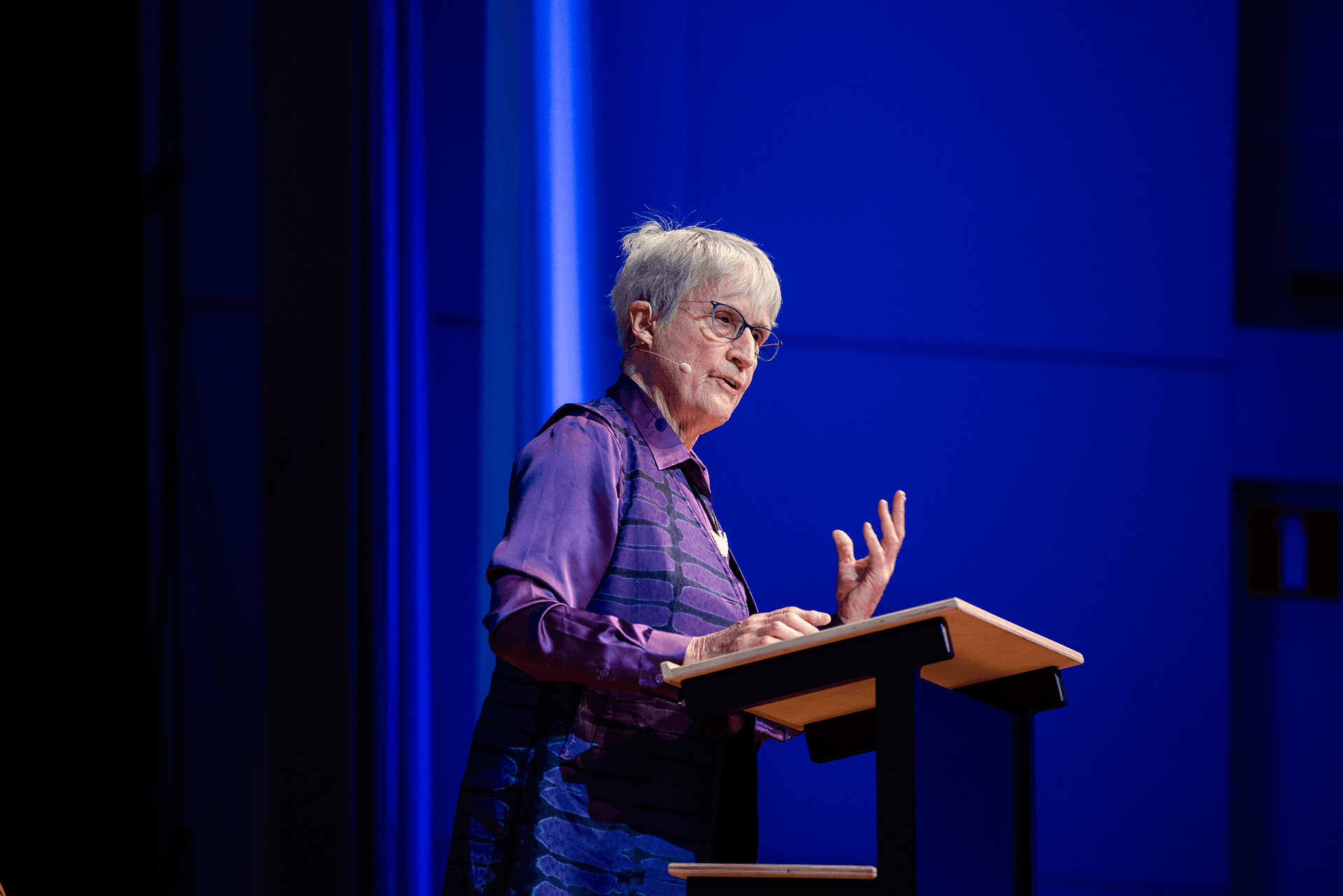
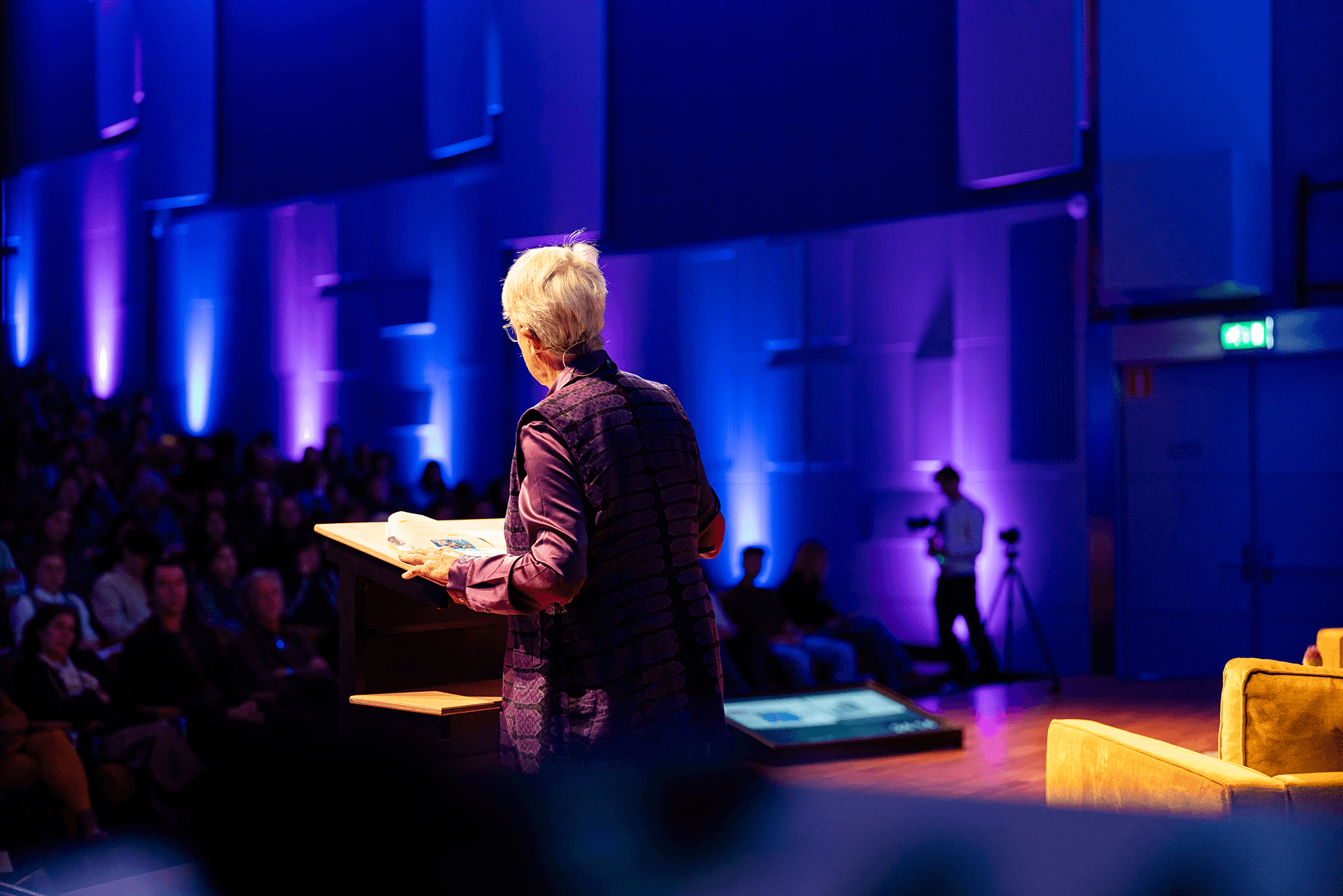
During a lecture on her work, introduced by Marli Huijer and opened by philosopher and author Stine Jensen, Haraway demonstrates how relevant her ideas remain.
She bluntly addresses the major challenges of our time: climate change, the pressure on democratic institutions, wars that destroy people and ecosystems. But despite her critical perspective, she doesn't lose sight of the future. She wants to show us that there are indeed possibilities for change.
A key concept in her work is that of “companion species.” This extends beyond pets or assistance dogs. It encompasses organisms with which we live in deep mutual dependence: from bees to bacteria, from trees to technology.
Haraway thus demonstrates that species do not exist in isolation: we are constantly entangled with one another.
In her conclusion, Haraway beautifully connects art, science, and politics. She depicts the monarch butterfly, known for its enormous migration journey and a symbol of transformation and hope. Migration, Haraway says, is not a problem to be solved; it is a natural part of life on Earth.
She concludes with a poignant image: moths and butterflies emerging from the rubble of Gaza. Her message is crystal clear: people, too, must be able to rise from destruction and continue to live together.
Haraway’s lecture is also a plea for action. The ecological crisis isn't a future scenario; it's here and now. We can't rely solely on large organizations: everyone can contribute, individually and collectively.
Regarding political developments in her home country, the United States, she is also sharp yet hopeful: under the pressure of authoritarian movements, resistance and the desire for a more just future are fortunately growing.
The same invitation resonates in response to various questions from the audience: let's stop thinking in absolute dichotomies. Not either human or nature, not either technology or emotion, not either right or wrong. We live in a world of relationships, dependencies, and interconnectedness.
Donna Haraway's full lecture can be viewed on Next Nature's YouTube channel.
Comments (0)
Share your thoughts and join the technology debate!
No comments yet
Be the first to share your thoughts!