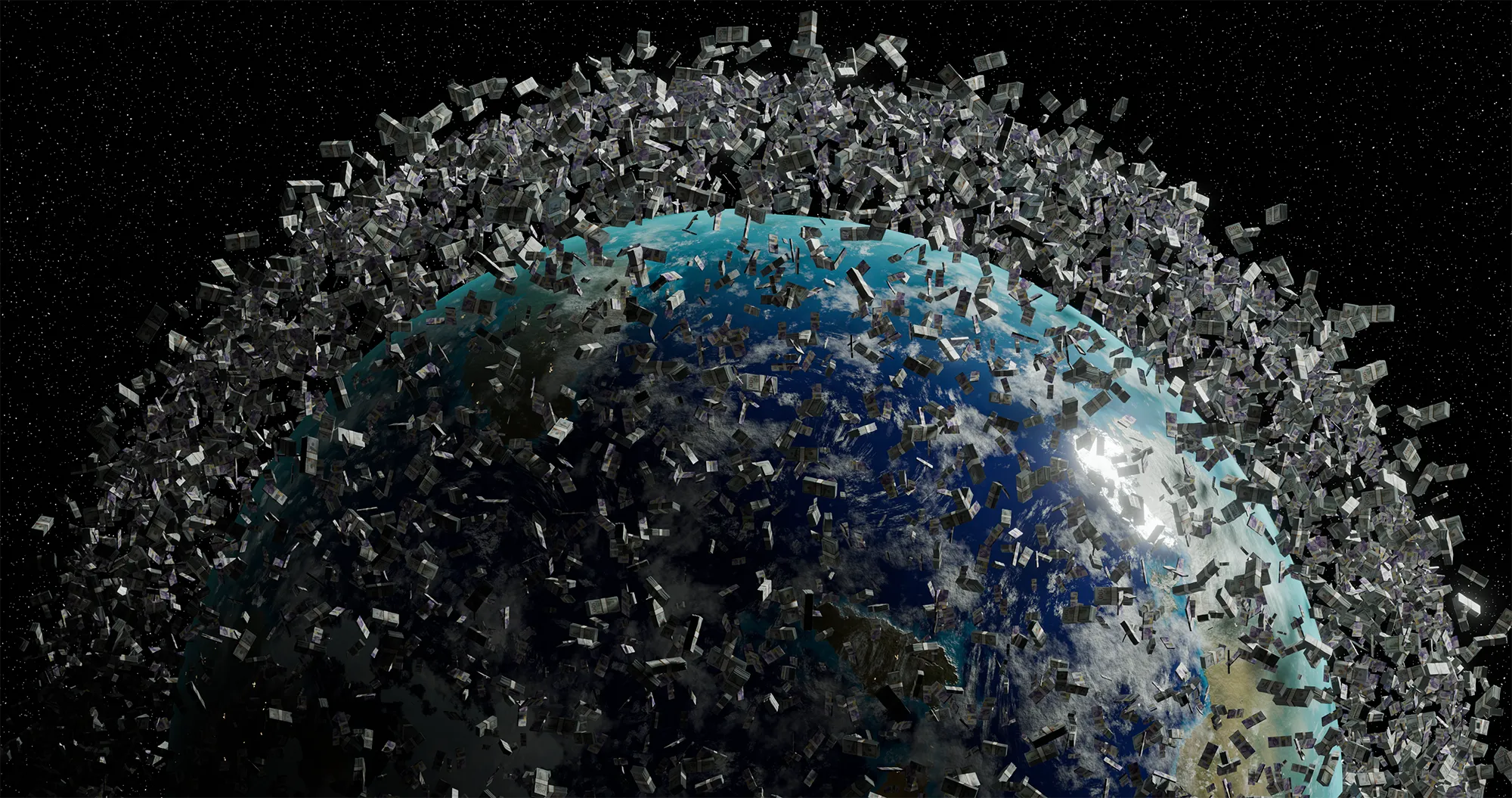
Once upon a time… there was Earth.
Mieke GerritzenOnce upon a time… there was Earth. Not a fairy tale, but the true beginning. A glowing sphere spinning through the black universe. Layer upon layer, always in motion. For billions of years, it created itself: volcanoes piled up land, oceans left their tracks, continents slowly shifted. It remains a mystery. There was no plan, no design, but it did come into being. And somewhere in that process of creation, humanity stepped aboard.
We live on a remarkable planet, a spaceship without a helmsman. We have only one Earth: there is no backup, no reset button, no exit. Everything we need to live comes from here: air, water, heat, food, and energy. But do we actually take that seriously enough? What do we actually know about this fragile rock in space?
In an age when our lives revolve around screens, data, and smart systems, we easily become disconnected from the Earth itself. The ground beneath our feet seems self-evident, until it talks back: with droughts, floods, fires, heat, and storms. The question arises: how do we continue to live on a planet that responds to our presence, yet we barely understand it? What does it mean to be the crew of a living spaceship?
We live in a time of tension. On the one hand, we struggle with shortages of raw materials, space, and tranquility. On the other, we are drowning in an abundance of things, information, and stimuli. Our bodies were once formed in times of scarcity, but now we must navigate a world of excess. We eat too much, scroll too much, produce too much. And we are becoming exhausted. Not only ecologically, but also mentally and socially.
Perhaps it's time for a change of course. No longer as exploiters of the Earth, but as crew members of a complex, living machine. As travelers responsible for the maintenance, direction, and balance on board. Because a ship that loses its balance risks losing its carrying capacity.
Slowly, the understanding is growing that humans, technology, and ecology are not separate domains. They form one interwoven whole. The Earth is not a pantry or an exploitation platform, but a dynamic system of which we are a part. Not a passive object, but a co-player. And instead of controlling it, we could learn to attune our behavior to its rhythms, tensions, and forces.
That calls for a different narrative. Not a quick technological fix, no nostalgia for a "pure" nature, but the realization that our planet is alive and that we must move with it. Beneath our feet lie layers of rock, fire, sediment, and fossil: traces of time, bearers of memory. If we learn to listen again to that slow intelligence, we can discover other forms of coexistence. Not as passengers, but as co-creators.
Imagination is not a luxury in this. It is a necessity to make the invisible tangible. In a culture that wants to accelerate, digitize, and optimize everything, the Earth's consciousness invites us to slow down, deepen, and coexist.
We don't need to return to simplicity or scarcity. But we do need to move forward, toward connection with the planet's evolution. Towards a world in which we understand and accept that the Earth is not stagnant, but is constantly reshaping itself. Where we no longer see ourselves as users, but as temporary residents of a vulnerable, resilient ship.
This requires not only knowledge, but attention. Not dominance, but collaboration. Because the future lies not in the clouds, but in the ground. In lava, sand, clay, stone. In the shifting foundation of a planet that carries us, layer by layer, wave by wave.
Once upon a time… the Earth. And it moves. Still.
Once Upon a Time… Earth is on display at the Next Nature Museum.
The exhibition was made possible with the support of the Cultuurfonds (partly thanks to the Van der Jagt Zwolsman Fund), NWO, and the Gieskes-Strijbis Fund.
Comments (0)
Share your thoughts and join the technology debate!
No comments yet
Be the first to share your thoughts!