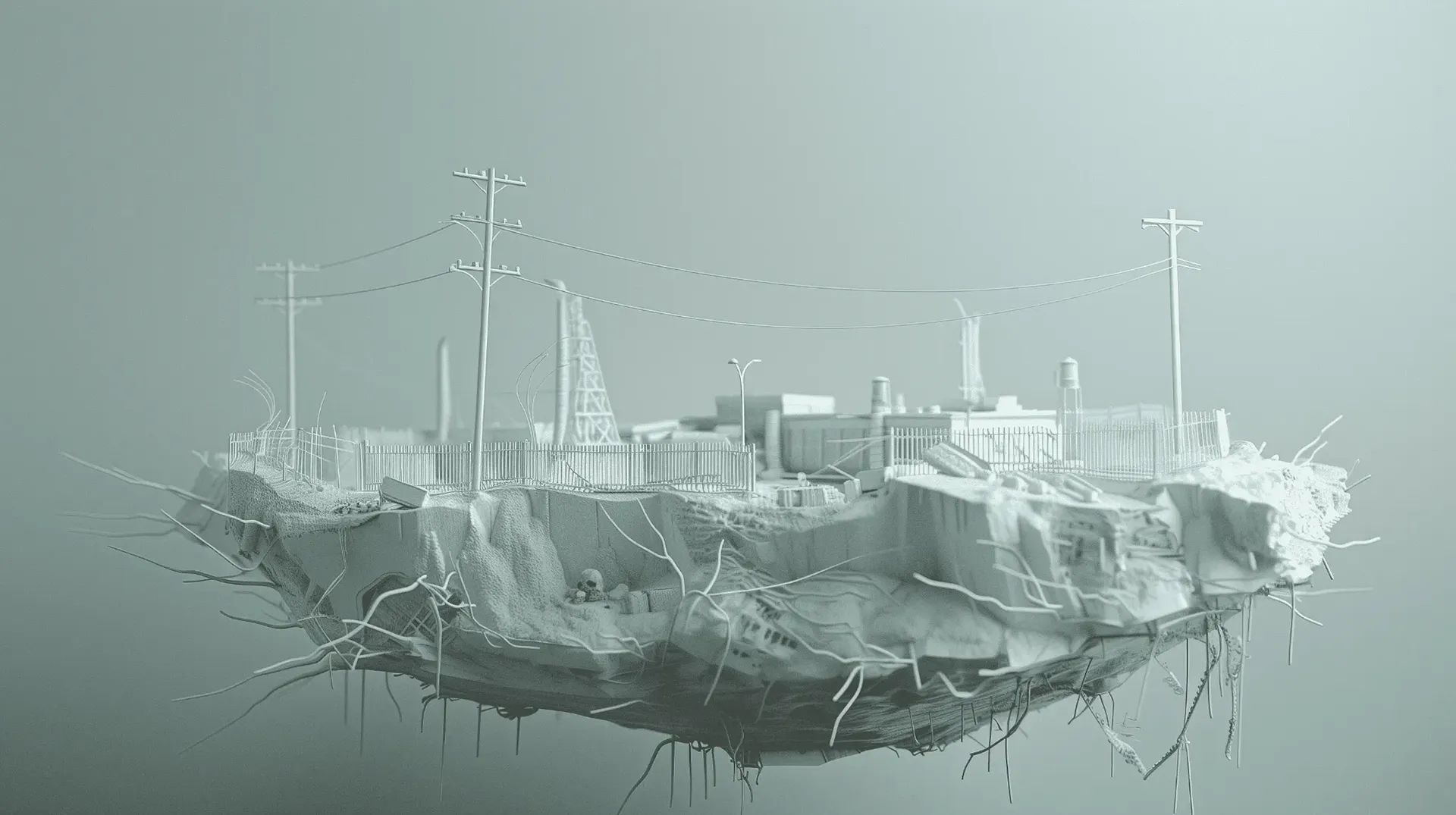
Lev Manovich: When AI becomes culture
Noor van EekelenAs one of the most influential thinkers in the fields of digital culture, media theory, digital art, and AI, Lev Manovich has been exploring for decades how - software, data, and artificial intelligence - shape our culture.
His classics, Database as a Symbolic Form and The Language of New Media, are considered standard works worldwide, and with books such as Artificial Aesthetics and the recent essay The Future of Art?, he continues to examine the question of what creativity means in an era where technology seems capable of making anything.
On October 23, we welcome Lev Manovich as a guest speaker at PROMPT, our conference on AI, art, and design, during Dutch Design Week at the Next Nature Museum.
Today, we already speak with Manovich about AI, art, and exactly what emerges when technology changes not only our tools, but also our culture.
In your well-known essay Database as a Symbolic Form from the late 1990s, you argued that the database had become a new primary cultural form, perhaps even more important than narrative. What cultural form is generative AI producing or taking over now? Is it still the database, or something new?
When I wrote about database as a cultural form in 1998, I was describing a shift in how culture organizes and presents information: not as a linear structure that presents a story which moves to a conclusion, but as a flat collection of items you navigate without any prescribed path. The database was still visible as a database — you could see the records, the categories, the interface.
Generative AI greatly scales the size of a cultural database (billions of images and trillions of text pages) and also makes it invisible for the users. The entire accumulated and digitized archive of human cultural production is now compressed into a latent space, and from that space any particular form can be summoned on demand.
If I had to name the new cultural form, I would say it is the “prompt” (or other parts of the input which can include images) — not as a technical instruction but as a cultural act, the gesture by which a human positions themselves in relation to this vast compressed totality and asks it to speak. The cultural logic is no longer navigation through a collection. Instead, it is a conversation with a giant human cultural archive via a machine that can act as an assistant, a colleague — sometimes as an alien intelligence.
In your recent essay The Future of Art?, you explore whether art might lose some of its central significance now that AI can produce increasingly convincing creative forms. What does this mean culturally? How do you think generative AI is changing the role of the artist or designer. And can AI be creative in the sense of truly inventing new cultural forms, rather than only recombining existing styles?
I don’t think that there is a singular thing that corresponds to the term “artist.”
- There are people who enjoy engaging in artistic activities.
- There are professionally educated artists who operate in the art wold - showing in galleries, art fairs and art centers (or want to show there). This type of art continues to focus on the aesthetic experience and the effects only possible via specific material form.
- And there are different kinds of artists who do art with social topics and show at biennales - this is more conceptual art, with ideas being more important than the form or aesthetics.
- And finally, we also have millions of people who make visuals inside culture industries - graphic and web designers, videographers, photographers, and others. In my view, the adoption of AI has very different effects on each of these types of artists.
In my view, these effects are significant for (1) and (4) - and less important for (2) and (3). The ‘artworld artists’ produce unique material objects, so AI which can so far only generate media does not affect them. “Biennale art” is focused on issues and ideas, as opposed to making aesthetically satisfying visuals - so AI as an image generator is not very relevant for this type of art.)
In relation to (1) - the numbers of people who can now externalize their aesthetic ideas they previously lacked the technical means to realize is growing — which I think is very good. Most jobs today do not require any creative invention, so if people can instead enjoy creative play outside of work more easily, this is wonderful.
On the other side, as the number of images online which are labeled as “art” keeps growing, it may become harder for people to appreciate the work of very serious and unique artists - unless it is about creating a visual spectacle and easy to understand content.
As for whether AI can truly invent new cultural forms rather than recombine existing ones — I am skeptical of such binary opposition. Human creativity has always been, to a very large degree, recombination of what already has been created. And GenAI is a fantastic tool for recombination of elements from our giant cultural archive. Whether these recombinations end up being meaningful and aesthetically satisfying or not — this depends on the author and not AI tools.
Who or what is - your - major source of inspiration? Which artist or thinker do you personally admire?
My daily inspiration comes from my Instagram feed, and the endlessly creative and accomplished projects done around the world that I encounter. I can be equally excited by such projects developed by AI researchers, by creative professionals in design, architecture, advertising and other fields, by giant companies and single people. One thing that currently especially inspires me is the range of "vibe coding / vibe design" projects people do now. The new ability to execute your ideas within (let's say) 30 minutes or 1 day as opposed to a week or months is truly revolutionary.
In terms of particular fields that I follow more than others — these are fashion design, graphic design, architecture, photography, contemporary academic music, contemporary dance and music video.
I don't spend much time on digital or media art. Artists in these fields are usually not focused on creating sophisticated aesthetic experiences — instead, the goal often is to communicate social ideas and political beliefs or present technology research. In contrast, cultural professionals in the fields I mentioned, or creatives in art fields that require years of training (academic music, dance) and who have a good knowledge of their fields' history, inspire me far more.
Next Nature views technology as second nature: what was once new, experimental, and exciting eventually becomes commonplace. Suppose we speak to you again in 50 years. How do you think people will look back on our current ideas about creativity and AI? Will AI have become just as ordinary by then?
AI will almost certainly become ordinary in the way electricity is ordinary: infrastructure that shapes everything without anyone stopping to reflect on it. This is what happened to computers in general, and later to the web and mobile phones. This ubiquity of AI is already partly here, and it will likely become full in about 4–6 years. Regarding "creativity" — this term was used much less frequently until the beginning of the 21st century. In the early 2000s, growing competition and easier access to foreign markets (the effects of globalization) motivated a new paradigm in business. Your company now needs to be 'creative' and it needs to innovate constantly. The global success of Apple and Samsung in the 2000s, based on their innovative strategies, became an example for all businesses.
Later still, the idea took hold that creativity is highly desirable for society as a whole and for individuals in general, and became a new universal social value in the 2010s. Everybody should be creative — and computer technologies are here to help us. (Which means that we all, to some extent, should become 'artists'.)
The new term 'creative technologist' that became popular in the 2010s is an example of these trends. This idea led to a different assumption — that AI and technology in general should help individuals and companies to be creative and innovative. And at the same time it also led to the questions constantly being asked today — can AI be truly creative?
If creativity (and also "art" as it is understood today) concept did not even exist in human history until recently, we can also imagine that they will become less important in the future. So I hope that in 50 years, people will be asking different types of questions, as opposed to still obsessing about "creativity and AI."
About Lev Manovich
Dr. Lev Manovich is a Presidential Professor at The Graduate Center, City University of New York (CUNY). Manovich played a key role in establishing several new research fields: new media and digital culture (1991–), software studies (2001–), cultural analytics (2005–), and AI aesthetics (2017–). This work has made him one of the most influential thinkers on digital culture and art today.
His publications include 17 books and 226 articles, reprinted over 460 times in 40 languages. Among these books, the most well-known are Artificial Aesthetics, Cultural Analytics, Instagram and Contemporary Image, Software Takes Command, and The Language of New Media, called "the most provocative and comprehensive media history since Marshall McLuhan."
Manovich's art projects have been exhibited in 14 solo and 125 international group exhibitions at leading cultural institutions, including the Institute of Contemporary Art (London), the Centre Pompidou, and the Shanghai Biennale.
Comments (0)
Share your thoughts and join the technology debate!
No comments yet
Be the first to share your thoughts!