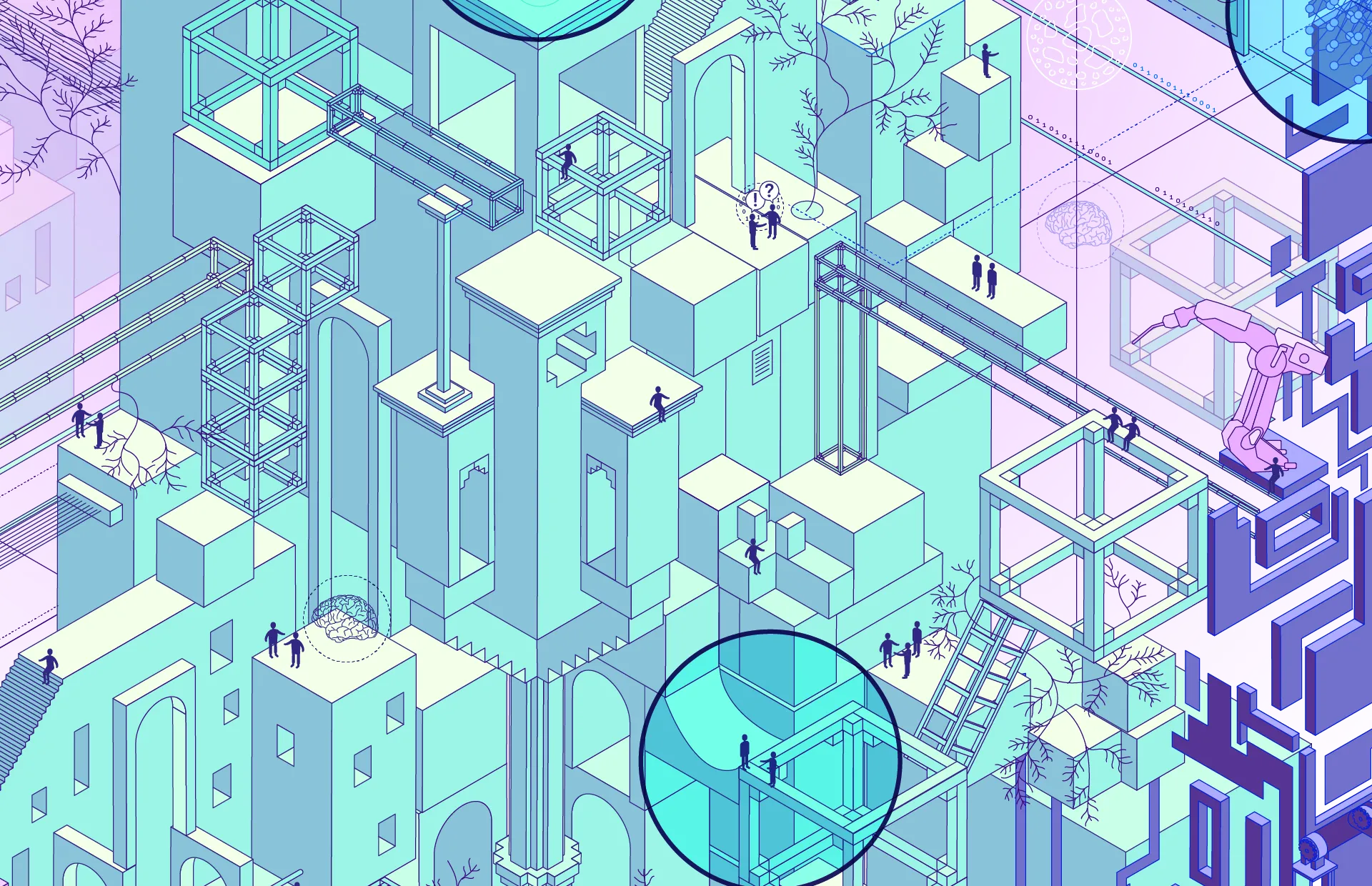
In 2030, AI makes room for the playing human
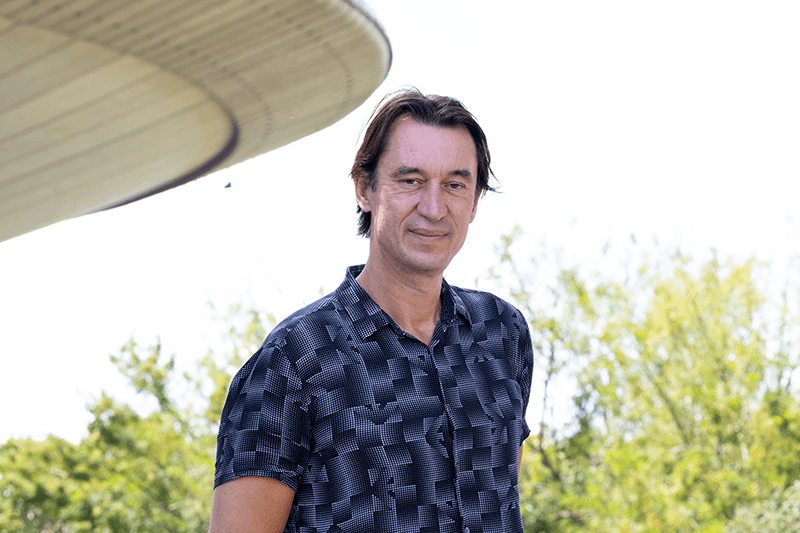
Koert van MensvoortWhat will the world of AI look like in 2030? Koert van Mensvoort, together with Dirma Janse, presents a hopeful vision of the future. The robot has become an ecosystem and the efficient human has given way to the playful human, all thanks to AI.
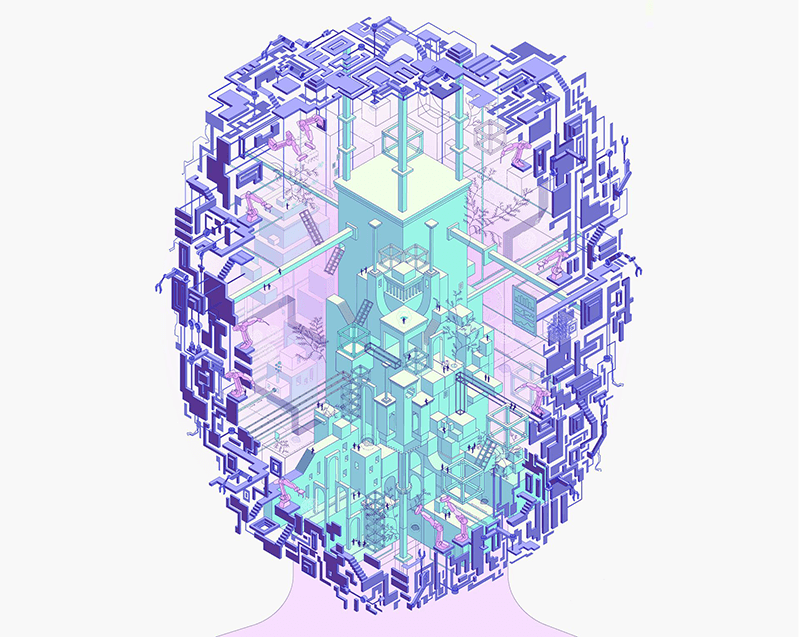
In the 2020s, futurists warned of mass redundancy caused by AI. The machine would replace us and take away our autonomy. But around 2030, a different reality is beginning to emerge. We have not been replaced by robots; the robot has grown around us. Just as a snail is connected to its shell and a spider to its web, the human being has become intertwined with a technological superorganism.
The fact that we now experience this mainly as a positive symbiosis is the result of a hard-fought transition. We did not allow the machine to rule; we claimed it as our new playing field.
For centuries, humans built systems to tame nature. Roads, sewage systems, electricity grids and metro networks brought order. We created a legal state of protocols, a healthcare system of checklists and a food supply that reduced the landscape to logistics. But there was a catch: we became trapped in maintaining those very systems.
The architect of freedom became the mechanic of his own cage; homo faber — the making human — spent his life greasing the wheels.
A Reason to Get Up
Around 2030, that seems to be changing. Take an ordinary Tuesday morning. You are not woken by an alarm clock, but by your house subtly adapting to your biological rhythm. While systems take care of their administrative and technical maintenance, your play begins. On your way to the park, the system connects you with a “player” from the neighborhood: a resident with a wild idea for a collective indoor garden. Work and leisure have become intertwined.
AI is not a screen you stare at, but an invisible assistant that looks along with you through a subtle pair of glasses or an earpiece. AI calculates the technical feasibility, while you discuss the human scale. You no longer enter data; you curate: the intuition that one particular tree should remain because of the shade, or that a path should be just slightly wider to allow for a good conversation. AI calculates; you give meaning.
The more technological our environment, the greater the challenge to remain human.
Now that we have let go of the steering wheel and AI keeps the systems running, attention shifts to what the Japanese call ikigai: a reason to get up in the morning. The intersection of what you love, what you are good at, what the world needs and what you are valued for. For one person, that may be care, education or public debate; for another, it may be understanding and maintaining the systems themselves.
This shift has an impact on the economy. Work in which human presence is indispensable gains value. A nurse already earns more than a surgeon, and a good waiter more than a notary. Not because knowledge is no longer valuable, but because knowledge is available everywhere, like water from the tap.
Although no universal basic income has yet been introduced, human labor has become virtually untaxed thanks to new legislation, while raw materials and data are taxed more heavily. In this, information functions as a new oil: those who pump up large amounts of data pay the bill. In this way, the nightmare that a small group of tech billionaires would draw all wealth toward themselves has been averted.
Free-Range Humans
The human being has become the luxury in an automated world. We pay less for thinking power and more for human power: for the gardener with a passion for flowers, the chef with a distinctive signature, a handwritten letter, or the genuine attention of a sports instructor that no algorithm can simulate.
Still, this is no flawless paradise. While the software of the superorganism gleams, the hardware of the old world creaks and groans. Sensors that measure the city’s breathing - from humidity to traffic flows - are often attached to rusting cast-iron pipes from the previous century. Skilled hands that keep the physical world running remain worth their weight in gold. A new social divide is also emerging. Moving between the sensors is a growing group of “free-range humans.”
Just as people once clung to cash as the last bastion of privacy, they choose a radically unpredictable life. They wear clothing that confuses facial recognition and avoid the smart routes of the algorithm. They refuse to be a data point. They play their own game.
The Gardener in the Machine
Now that thinking power has become a cheap utility, the efficient human makes way for the playing human: homo ludens. Our added value lies in the unexpected, in moral intuition and in soulfulness — qualities that do not arise from optimization, but from involvement.
In 2030, we are no longer the engineers of a mechanical world, but the gardeners of a technological ecosystem. The more technical our environment becomes, the greater the challenge of remaining human. It resembles a large-scale glass bead game, in which technology, art and life are interwoven. Within it, the human being is no longer an accessory to the machine, but the soul of the system.
The robot is no longer a cage, but an ecosystem that maintains itself. Will there still be challenges? Always, because playing well is hard work. And the great game has finally begun.
This article has been published in NRC on April 24, 2026. The images are created by illustrator Dirma Janse.
Comments (0)
Share your thoughts and join the technology debate!
No comments yet
Be the first to share your thoughts!